National Cadet Corps
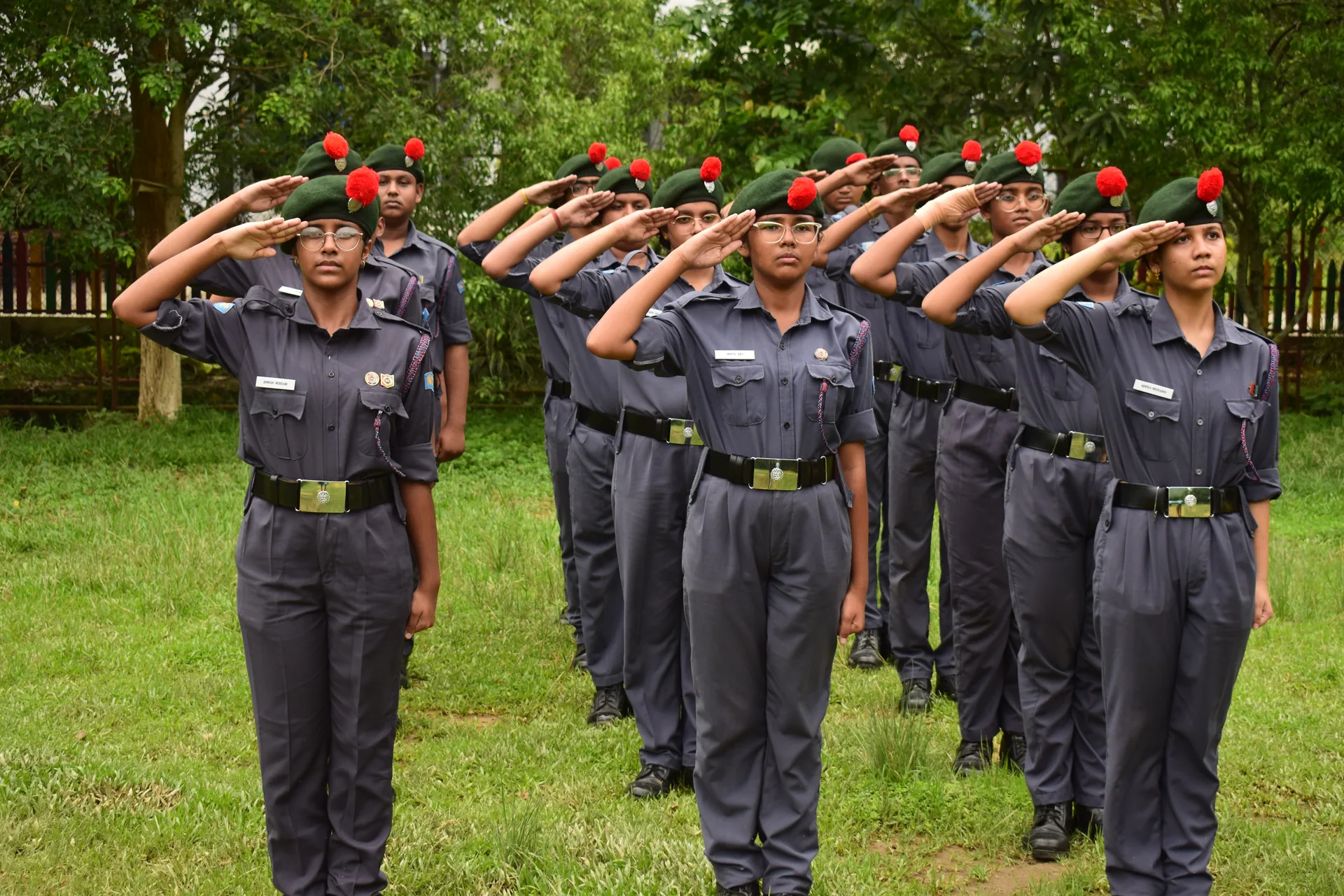
The NCC is the youth wing of the Indian Armed Forces — a tri-service organisation comprising the Army, the Navy and the Air Force. At Axel, the NCC programme is open to students on a voluntary basis and builds the qualities that no examination can test: discipline, unity, leadership and service to the nation.
Est. nationally 1948 · Motto: Unity and Discipline · Tri-Service Organisation
Navy, Air Force
in India
military service
from Class VIII
NCC at Axel
A programme that builds citizens, not just cadets.
The National Cadet Corps is a voluntary programme open to school students across India. At Axel, NCC enrolment is available from Class VIII onward. Cadets receive basic training in drill, small arms, map-reading and first aid — practical skills that complement and deepen everything learned in the classroom.
Participation in NCC carries no obligation for active military service after the programme concludes. What it does carry is a record of disciplined commitment that universities, employers and selection boards across India recognise immediately. The NCC ‘B’ and ‘C’ certificates attract direct benefits in government recruitment and university admissions.
Adopted at the 12th Central Advisory Committee meeting in October 1980, the motto reflects the NCC’s core purpose: to bring together the youth of India from every background and mould them into united, disciplined citizens. At Axel, the motto is not a slogan — it is the standard against which every cadet measures themselves.
A tri-service organisation
The NCC is one of the few cadet programmes in the world to span all three military services simultaneously.
Army Wing
The founding wing of the NCC, established in 1948. Army cadets are trained in drill, obstacle courses, map reading, weapon handling and field craft. The Army Wing also leads the NCC’s social service activities, including disaster relief, traffic management and community outreach programmes.
Uniform: Olive green · Est. 1948
Air Wing
Added to the NCC in 1950, the Air Wing introduces cadets to aviation fundamentals, meteorology, aircraft recognition, model aeroplane building and gliding. Cadets with strong performance are eligible for flying scholarships at the Air Force Flying Colleges, one of the few civilian pathways to piloting experience in India.
Uniform: Light blue · Est. 1950
Naval Wing
Established in 1952, the Naval Wing covers seamanship, knot craft, boat pulling, navigation and naval history. Selected cadets participate in naval training aboard ships and at INS establishments. For students from landlocked Assam, the Naval Wing offers a genuinely rare and formative experience.
Uniform: Navy white · Est. 1952
What the NCC builds
Skills and qualities that stay with cadets long after the uniform comes off.
Punctuality, correct turnout, and respect for hierarchy — practised daily until they become instinct.
Cadets lead drills, manage junior members and take decisions under pressure in field exercises.
Physical training and camp life push cadets beyond their comfort zone in a structured, supported environment.
All cadets are trained in basic first aid and emergency response — a life skill the NCC treats as non-negotiable.
Practical orientation, compass work and field navigation — taught in the terrain around our campus.
Precision marching and parade drill instil physical coordination, collective focus and pride in presentation.
NCC cadets participate in social service projects, tree plantation drives, and local civic initiatives throughout the year.
NCC camps bring together cadets from across India. Axel cadets train and live alongside students from different states, languages and backgrounds.
‘B’ and ‘C’ certificates are recognised in government recruitment, defence services, and university admissions across India.
A brief history of the NCC
From the University Corps of 1917 to India’s largest uniformed youth organisation.
Origins — 1917 to 1948
The NCC traces its lineage to the University Corps, created under the Indian Defence Act 1917 to address a shortage of military personnel. In 1920, this became the University Training Corps (UTC) under the Indian Territorial Act, part of a deliberate effort to ‘Indianise’ the armed forces. By 1942, the corps had been renamed the University Officers’ Training Corps (UOTC).
After World War II, the UOTC was assessed as insufficient for the nation’s needs. A committee headed by H. N. Kunzru recommended a new national cadet organisation spanning schools and universities. The NCC was formally established in 1948. The first unit was raised at Delhi on the fourth Sunday of November — a date still observed nationally as NCC Day — with India’s first Prime Minister, Pandit Jawaharlal Nehru, presiding.
Growth — 1949 to present
The Girls Division was formed in 1949, followed by the Air Wing in 1950 and the Naval Wing in 1952, completing the tri-service character of the organisation. Community development and social service were added to the NCC syllabus at the direction of Pandit Nehru, reflecting his belief that cadet training should serve the nation in peacetime as much as in conflict.
During the 1965 and 1971 wars, NCC cadets served as a second line of defence — managing ordnance supply lines, supporting civil defence authorities, and assisting in rescue and traffic control operations. Following both conflicts, the NCC syllabus was revised to place greater emphasis on leadership, social service and youth management — the framework that remains in place today.
Unity and Discipline.
NCC enrolment at Axel is voluntary and open to students from Class VIII onward. There is no obligation for military service. There is every reason to join.